

UL 217 10th Edition Explained: What Smoke Alarm Importers and Distributors Need to Know Before Placing Their Next Order
Meta title: UL 217 10th Edition Smoke Alarm Standard — B2B Buyer's Guide | Heiman Technology Meta description: UL 217 10th Edition raises the bar for smoke alarm certification in the US and Canada. Learn what changed, why it matters for sourcing, and how Heiman's UL 217 10th Ed. certified alarms keep your product line compliant.
Quick Answer
UL 217 10th Edition is the newest ANSI/UL safety standard for single- and multiple-station smoke alarms, published November 27, 2024 and ANSI-approved January 14, 2026. It harmonizes US requirements with Canada's ULC S531 5th Edition, adds a formal cooking-nuisance resistance test, and introduces low-frequency audibility requirements for sleeping occupants. For B2B buyers, this means: alarms certified only to older editions (8th or 9th) may not meet the compliance expectations that code officials, insurers, and end customers will demand going forward. Heiman Technology's HM-638/HM-636 series and related product lines are independently tested and listed to UL 217 10th Edition, giving distributors a compliant SKU ready for both the US and Canadian markets.
Why This Update Matters to Your Sourcing Strategy
If you import, distribute, or private-label smoke alarms for the North American market, a standard revision is not just a technical footnote — it directly affects which products you can sell, into which channels, and for how long.
Two forces are driving this update:
- Fire dynamics have changed. Modern furnishings and construction materials burn faster and produce different smoke characteristics than they did a generation ago. Average escape time in a residential fire has dropped from roughly 17 minutes decades ago to just 3–4 minutes today.
- Nuisance alarms undermine safety. A widely cited U.S. Consumer Product Safety Commission study found that smoke alarms were disabled or non-functional in nearly half of home fires — often because occupants had grown tired of false alarms triggered by cooking.
UL 217 10th Edition addresses both issues directly, and it does so on a unified US–Canada basis for the first time.
What Changed in UL 217 10th Edition
1. US–Canada Harmonization
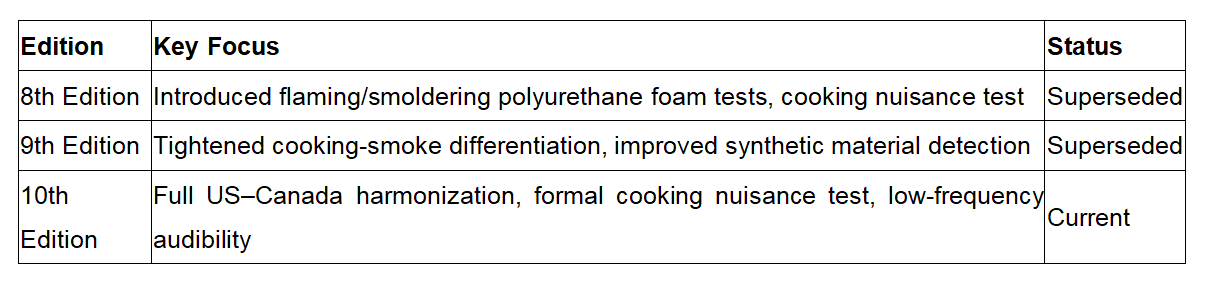
The 10th Edition retains every requirement from the 8th and 9th Editions and adds performance criteria that align with Canada's ULC S531 5th Edition. Fire test scenarios are now identical for US- and Canadian-certified alarms, simplifying dual-market product development and certification for manufacturers who previously had to run separate test programs.
2. Cooking Nuisance Alarm Resistance Test
Cooking smoke has long been the leading cause of disabled smoke alarms. The 10th Edition formalizes a standardized pan-frying and toaster test protocol that alarms must pass without triggering false alerts, while still responding to genuine hazards.
3. Go/No-Go Flaming Polyurethane Test
Conducted immediately after the cooking nuisance test, this evaluates whether an alarm can correctly distinguish a hostile fire from a non-hostile nuisance source — a direct response to the prevalence of polyurethane foam in modern furniture.
4. Low-Frequency Audibility Requirements
New provisions apply to alarms capable of low-frequency sound output, addressing research showing that lower-frequency tones are more effective at waking sleeping occupants, including those with hearing loss.
5. Continued Dual-Fire-Type Detection
As with the 8th and 9th Editions, alarms must reliably detect both fast-flaming fires and slow-smoldering fires — the two fire behaviors most commonly encountered in residential settings.
UL 217 Edition Comparison
How Heiman Meets the New Requirements
Heiman Technology's hardwired interconnected smoke alarm, the HM-638/HM-636 series, is independently tested and listed to UL 217 10th Edition, with compliance validated across several key sections:
- Nuisance Alarm Resistance (Cooking Smoke): Proprietary signal-processing algorithms are validated under standardized pan-frying and toaster protocols, reducing false alarms from everyday cooking without sacrificing response time to real fires.
- Photoelectric Response Requirements: Meets sensitivity and timing thresholds for both smoldering (paper/cotton) and flaming (wood) fire tests, with optimized particle-size discrimination.
- Interconnection Performance: Supports up to 40 interconnected units, critical for multi-unit residential and hospitality properties.
- 10-Year Sealed Lithium Backup Battery: Automatically engages during AC power outages, maintaining continuous monitoring and full interconnect functionality without field maintenance.
For smart-home channels, Heiman's Matter-enabled photoelectric smoke detector line is also UL 217 10th Edition certified and interoperable with Apple Home,Homey,Google Home, SmartThings, and Home Assistant — giving distributors a compliant option for both traditional hardwired and connected smart-home product lines.
What This Means for Distributors and Importers
- Spec sheets should reference "UL 217 10th Edition" explicitly, not just "UL 217," to avoid ambiguity with buyers, code officials, or retail compliance teams.
- Dual US/Canada certification reduces SKU complexity — a single 10th Edition-certified product can typically serve both markets without separate Canadian variants.
- Insurance, code, and retail-channel requirements will increasingly reference the newest edition as the transition period progresses, making early adoption a competitive advantage rather than just a compliance checkbox.
- OEM/ODM buyers should confirm test section coverage (nuisance resistance, photoelectric response, interconnection performance) rather than relying on the edition number alone, since compliance documentation varies by manufacturer.
Frequently Asked Questions
When did UL 217 10th Edition take effect?
UL 217 10th Edition was published November 27, 2024, with ANSI approval on January 14, 2026. Manufacturers and buyers should check with UL Solutions or their certification body for the current transition timeline applicable to their market.
Does UL 217 10th Edition replace the 8th and 9th Editions?
Yes. The 10th Edition incorporates all requirements from the 8th and 9th Editions and adds the harmonized US–Canada performance criteria on top of them.
Is a UL 217 10th Edition certified alarm also valid for the Canadian market?
Products certified to UL 217 10th Edition alongside ULC S531 5th Edition use identical fire test scenarios for both countries, which is the core purpose of the harmonization update.
What is the biggest practical change for end users?
Reduced false alarms from cooking, combined with low-frequency audibility options that improve wake-up performance for sleeping occupants — particularly relevant for hospitality, senior housing, and multi-family residential buyers.
Where can I get the official standard text?
The full standard is available for purchase directly from UL Standards & Engagement (shopulstandards.com) or ANSI's webstore. This article summarizes publicly available information and should not be treated as a substitute for the official standard document.
Work With a Certified Manufacturer
Heiman Technology supplies UL 217 10th Edition certified smoke alarms — hardwired and battery-powered, standalone and Matter-connected — for distributors, importers, and OEM/ODM partners across North America. Contact our team for certification documentation, sample requests, and private-label options.
Sources
- UL Solutions — "UL 217, Standard for Smoke Alarms Published with New Technical Requirements": https://www.ul.com/thecodeauthority/knowledge/ul-217-standard-smoke-alarms-published-new-technical-requirements
- UL Standards & Engagement — Official standard record, Edition 10, Published Nov 27, 2024 / ANSI Approved Jan 14, 2026: https://www.shopulstandards.com/ProductDetail.aspx?productId=UL217_10_S_20241127
- ANSI Webstore — UL 217 Ed. 10-2024 standard listing: https://webstore.ansi.org/standards/ul/ul217ed102024
- Intertek — "What UL 217, 10th Ed./ULC 531 5th Ed. Means for Alarm Manufacturers" (harmonization details, low-frequency audibility): https://www.intertek.com/blog/2026/01-06-what-ul-217-means-for-alarm-manufacturers/
- Code Red Consultants — "New UL 268 & 217 Editions" (8th edition effective date, escape-time research, polyurethane foam test description): https://coderedconsultants.com/insights/new-ul-268-217-editions/
- In Compliance Magazine — "Eighth Edition of UL 217, Standard for Smoke Alarm" (8th edition new test list): https://incompliancemag.com/eighth-edition-of-ul-217-standard-for-smoke-alarm/
- Rely Safety — "Why it's Essential to Choose UL 217 8th and 9th Edition Smoke Alarms" (9th edition improvements): https://relysafety.com/why-its-essential-to-choose-ul-217-8th-and-9th-edition-smoke-alarms/